Our Father, Who art in heaven, Hallowed be Thy Name. Thy Kingdom come. Thy Will be done, on earth as it is in Heaven. Give us this day our daily bread. And forgive us our trespasses, as we forgive those who trespass against us. And lead us not into temptation, but deliver us from evil. Amen.
‘The Lord’s Prayer ‘is truly the summary of the whole gospel.’ ‘Since the Lord… after handling over the practice of prayer, said elsewhere, ‘Ask and you will receive, ‘ and since everyone has petitions which are peculiar to his circumstances, the regular and appropriate prayer (the Lord’s Prayer) is said first, as the foundation of further desires.
Tertullian, De orat. from the Catechism of the Catholic Church; 2761.
Rev Fr. Mothusi Sidney BOATILE OMI – Provincial Administrator of the Lesotho Province
We celebrate our Founder Saint Eugene De Mazenod May 21st 2020
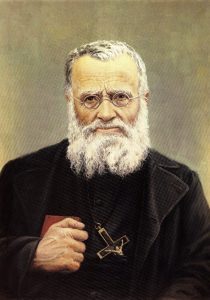
Dear Missionary Oblates of Mary Immaculate, Missionary Associates of Mary Immaculate, Friends of the Oblates and the Ex-Oblate Scholastics. The Month of May is very important to our Mazenodian family. We celebrate our Founder Saint Eugene De Mazenod (May 21st) and one of the first Oblates to evangelize Lesotho, Blessed Joseph Gerard (May 29th).
De Mazenod was fully aware of the struggles and difficulties that Gerard faced especially because of the Africans who would not want to convert to the Christian and Catholic faith. Our family is affected by the many challenges brought by COVID19 Pandemic. Struggles to survive and to do mission are some frustrating factors in our current situation. Some feel like we are not doing enough, others feel like they are not cared for adequately. Further, others see this or that and some are overworking themselves in an attempt to make life a little bit easier or even to make it possible to do the mission.
May, the Month of Blessed Joseph Gerard and Saint Eugene
Joseph Gerard might have felt the same when all his efforts seemed not to bear fruits. Factors such as not having converts and no African community must have led to a strong feeling of desolation, which of course could ultimately lead to depression, burn out, anger, and aggressive attitudes. Allow me to quote some messages that De Mazenod wrote to Gerard at that time, and read them as messages addressed to you by the Founder:
“It is a real pleasure for me to follow you step by step in the advances and setbacks of your missions… The least of your successes would be considered by me as a great blessing from God. Your reward, as you know, will not be measured by your success but by the work you have done and by the efforts of your zeal. Moderate this, however, so as not to go beyond your strength and run the risk of falling ill.” (October 28, 1859).
“Victory is promised only to perseverance. Fortunately, the reward is not measured solely by success and you need only to have worked to that end in order to achieve it.” (September 4th, 1860).
As we celebrate Eugene De Mazenod and Joseph Gerard, let us learn from the letters of the former to the latter that we have to work hard but moderately despite the prevailing challenging times. May St. Eugene De Mazenod and Blessed Joseph Gerard Pray for us.
Rev. Fr. Sidney Boatile OMI, The Provincial Administrator of the Lesotho Province invites you all to continue to celebrate the Season of Easter mindful of the threat posed by this pandemic, COVID -19
Fr. Charles Phoofolo omi is the Best Guitarist in the Province, while Fr. Selbourne Pita omi is known for his good voice, as a result, they complement each other so well,
The 36th General Chapter stipulates that formation is considered from the perspective of the mission. Subsequently the Oblate Province of Colombo, Sri Lanka offers an opportunity to its students to have a guided pastoral exposure for a period of one year done after 2nd year of Theological studies. This pastoral exposure is organized under the banner called Asian Institute of Theology (AIT) which is an endeavour of the Oblate Province of Colombo to bridge a gap between theoretical and praxis theology.
Br. Justice Thato Machesetsa, living at Oblate Scholasticate, Sri Lanka. He is doing third year theology at National Seminary, Ampitiya
The objective of this program is to assist students in formation with the better pastoral experience which forms an integral part of formation together with intellectual, spiritual and human aspects of formation. AIT, therefore, becomes a contextual immersion program where oblate students interact with the people to know their life struggles and thereby encountering God who has pitched his tent among the people in the journey of life.
Stages of the Program
Br. Ephraim Rorisang Manatha, living at Oblate Scholasticate Sri Lanka, doing the third year theology, National Seminary, Ampitiya.
The first stage was an encounter with a renowned Asian Theologian by the name Professor Aloysius Peiris SJ. He is Sri Lankan Jesuit who has taught in more than 20 Universities in the world and his purpose was to set a tone to our AIT immersion program. It was under him that we came to learn that Theology is not merely faith seeking understanding but Faith promoting Justice, thereby becoming liberating theology which has an impact on people’s lives.
The second was an engagement in the Free Trade Zone where we became employed as labourers in the garment factory. We became machine operators stitching in the lines. It is in such factories where young vulnerable boys and girls are employed under the conditions of so-called cheap labour and in that way a factory earning more profits while paying the minimum wages to its labourers. It was those boys and girls with whom we shared life setbacks.
The third stage was an association with the fishing-folk. Fishing is one of the main occupations in Sri Lanka as an island country. However, it is those of low cast who engage in this activity as their source of income. Unfortunately, many times they are side-lined by the country authority without being assisted with proper equipment to carry out their work.
Br. John Masakale Mphachane, doing third-year theology, Oblate Scholasticate, National Seminary, Ampitiya, Sri Lanka
In the final analysis, having mingled with the poor in these above-mentioned faces, we became able to deepen our personal religious commitment to serve the most abandoned by becoming sensitive to and growing in the awareness of the complexities of ever-changing realities of life in a spirit of mutual dialogue and interactive listening. Nonetheless partaking in this program we experienced some challenges such as having been employed even though we did not possess working visas of the country and some language limitations being a stumbling block. But ultimately we have gained so much experience to the effect that we hope it will be essential for our future ministry.
Rev. Fr. Motlatsi Selbourne Pita, Parish Priest of St. Charles Mission, Butha Buthe has his view on the Sacred Music
Music is both an integral part of our lives and liturgy. In our lives, we eat with it, drive with it, shop with it and relax with it. In our liturgical celebrations, we pray with it. I would like to focus our attention on the role of music in our liturgical celebrations. First and foremost, liturgical music can touch people in a way that a sermon cannot. Music can bypass intellectual barriers and take the message straight to the heart. Secondly, sacred music is a powerful tool of evangelization. David once said, “He put a new song in my mouth…Many people will see this and worship him. Then they will trust the LORD.” Ps 40:3. This shows an intimate connection between a song (sacred song) and evangelization. Sacred music is a vehicle that carries divine word. Thirdly, I think it is this kind of music that led Aristotle to conclude that “Music has the power to shape the character”. Fourthly St Augustine warns us against being tempted to take too much pleasure in the music rather than in the words. He puts it thus: “Yet when I remember the tears I shed, moved by the songs of the Church in the early days of my new faith; and again when I see that I moved not by the singing but by the things that are sung when they are sung with a clear voice and proper Modulation-I recognize once more the usefulness of this practice. Yet whenever it happens that I’m more moved by the singing than the thing sung, I admit that I have grievously sinned, and then I should wish rather not to have heard the singing” (Confessions, Book X, Chapter 33). Lastly, the Church looks upon sacred and liturgical music as a treasure of inestimable value greater even than any form of art cf S.C 112. As the Oblates of Lesotho Province, we are grateful to God for the massive contribution and musical treasure that is left by the late His Grace Archbishop Emmanuel ‘Mabathoana and Br Reginald Mbamba. May the good Lord help us to cherish that great treasure and inspire us to create more new sacred songs for evangelizing the poor worldwide.
Brother Thomas Reitumetse Mabitle, OMI He is doing Second-year theology at Gregorian University, Rome Italy.
In the name of Christ Jesus our Savior and of Our Mother Mary Immaculate I would like to greet you all dear oblates of Lesotho. Our world is going through a difficult moment in which humanity is being hit by a viral pandemic. I would also like to share with you the situation here in Italy, one of the countries most hit by this pandemic, how this has affected the church, our community here at the General House and the International Roman Scholasticate. Italy has more than 92000 confirmed coronavirus cases of people who tested positive; the number of the deceased has gone beyond 10000(may their souls rest in peace), the majority of whom are in the northern part of the country, in the region of Lombardy. This rapid increase in the number of people who are infected and who are dying has chocked the inhabitants of this country. Many people die alone isolated from their beloved ones and this is a very painful experience to many. Nevertheless, there are more than 12000 recorded cases of people who have recovered. We also hear often, a good number of Italians saying these words on TV and in social media, “ANDRA TUTTO BENE” which translates to “everything will go/be well” these are words of hope that this pandemic will not lead us to the end of the world. The church has been heavily hit by this pandemic as she sees the children of her own, suffering and dying. Churches have been closed, all school including church schools and universities have been closed. We also heard of more than 50 cases of deaths of priests (may their souls rest in peace). However, the church is always united in and through prayer with the people of God who are suffering. On Friday 27/03/2020, the World received a special blessing, Urbi et Orbi, from the Holy Father and we experienced the love of our mother the church has for us, the mother who is always with her children even in the moments of great difficulty. The community at the general house is going through a moment of solitude since there are no more interactions between members of the community and of the Scholasticate. We used to share some meals and some moments but now we do no longer have such moments. This time of solitude has however been interpreted positively by the members of the community of the scholasticate. We take this moment as an opportunity to be with The Lord, as the moment of intense prayer and of nourishing one’s relationship with the Lord especially during this season of land. This moment has also reduced our everyday needs because we are always in the house, hence, with the consent of all members, the community has decided to reduce monthly allowances by 50% and use the other 50% to help the poor who are mostly hit by this pandemic. We are encouraged by the words of the apostle when, in prison, wrote to the Philippians, “Now I want you to realise, brothers, that the circumstances of my present life are helping rather than hindering the advance of the gospel” (Ph. 1: 12). I see at this moment; a sense of Oblate Charism being reawakened even more in our community. I would like to share all my joys and hopes with you, the joys and hopes, which are not carried away by fears even amid this pandemic. My faith is still stronger than any of my fears. I am still healthy and there are no signs of infection apparently on my part, and on that of the other members of the community, I am still united with you in spirit and prayer.